
Solar Power Panel Installation: A Clear Guide to Efficient Domestic and Commercial Systems

Switching to solar power can cut your energy bills and reduce carbon emissions while increasing your home's resilience during outages. You can get a reliable estimate of costs, savings, and installation time by assessing your roof, local sunlight, and available incentives before contacting installers.
You will learn the practical steps that make installations go smoothly: choosing panels, sizing your system, securing permits, and hiring qualified installers. Knowing basic maintenance needs and common regulatory requirements helps you avoid delays and protect performance over time.
Key Takeaways
Assess your roof, sunlight, and finances to estimate costs and savings.
Follow practical steps—system sizing, permits, and qualified installers—to complete installation.
Keep up maintenance and compliance to preserve performance and warranty coverage.

Key Steps for Solar Power Panel Installation
You will assess roof structure, shading, and orientation; choose compatible panels, inverters, and mounting hardware; position panels for optimal tilt and azimuth; and complete safe electrical connections that meet local regulations.
Site Assessment and Planning
Inspect roof type, age, and remaining life first. Measure usable roof area and record azimuth and tilt with a compass and inclinometer. Identify shading from nearby trees, chimneys, or neighbouring buildings across seasons; perform a solar path analysis or use a shading map.
Check roof load capacity and rafter spacing. Confirm roofing material (tile, slate, metal, felt) because that determines mounting brackets and flashings. Note access for installers and location of the consumer unit and meter for cable routing.
Obtain local planning permission and grid-connection requirements. Request accurate export/import tariff info from your DNO. Prepare a sketch of panel layout, cable runs, and inverter position for permit applications and installer quotes.
When considering solar panels London UK, working with Solar Panels London UK ensures a professional site assessment and tailored system design for your property.
Selecting System Components
Match panel wattage and efficiency to your available roof area and budget; typical residential panels range 330–445 W. Select an inverter type: string inverter for uniform roof sections, microinverters for complex shading or multiple orientations, or a hybrid for battery integration.
Choose mounting rails and clamps rated for local wind and snow loads; check corrosion resistance for coastal locations. Select PV cables (typically 4 mm²–6 mm² DC for short runs) and MC4-compatible connectors. Include an AC isolation switch, DC isolator, surge protection device (SPD), and appropriately rated circuit breakers.
If planning batteries, pick chemistry (Li-ion, lead-acid), usable capacity, and round-trip efficiency; ensure inverter supports battery management. Confirm warranties: panels (usually 25 years), inverters (5–12 years), and workmanship guarantees.
Solar Panels London provides expert advice on selecting the right solar panels London UK for both domestic and commercial needs.
Mounting and Positioning Panels
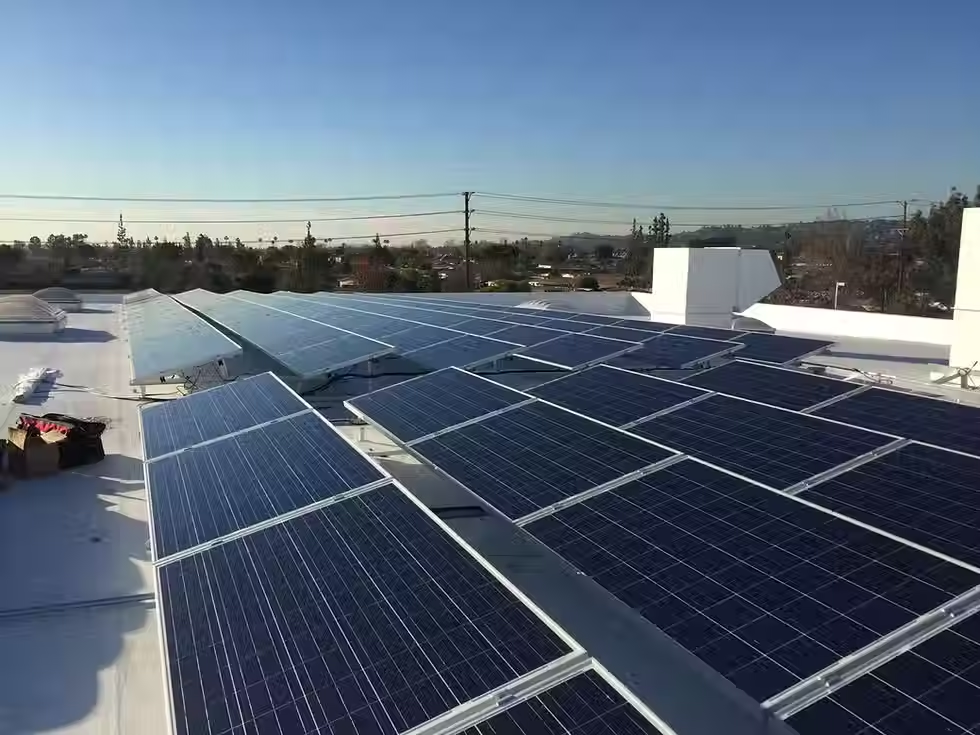
Position panels on roof sections with highest annual irradiance—usually south-facing in the UK—with tilt angles between 25°–35° for good year-round yield. For east/west arrays, split strings by orientation and use microinverters or optimisers to mitigate mismatch losses.
Install rails level and parallel to roof battens; use roof-specific mounting kits for tiles or trim for metal roofs. Apply flashing and sealants at all roof penetrations. Fasten with torque-controlled stainless-steel bolts to prevent loosening and water ingress.
Maintain clearances for ventilation and fire access routes per local code. Space rows to avoid self-shading at low sun angles; calculate row spacing using panel height and desired minimum sun angle. Label array orientation and inverter location for future maintenance.
Solar Panels London ensures your solar panels London UK are installed for maximum efficiency and compliance with local codes.

Electrical Connections and Safety
Route DC cables in conduit or UV-rated trunking, minimising length to reduce voltage drop. Keep positive and negative conductors together to limit electromagnetic interference. Use correct polarity and torque for MC4 connectors and document cable cross-sections and lengths.
Install a DC isolator near the array and an AC isolator near the inverter. Fit SPD devices on both DC and AC sides and earth the array frame per BS 7671 requirements. Ensure RCD protection and use appropriately rated consumer unit breakers.
Test after installation: insulation resistance, polarity, earth continuity, and full-system commissioning tests to confirm MPP tracking and inverter settings. Register the installation with the Microgeneration Certification Scheme (MCS) or local equivalent and notify your Distribution Network Operator before energising.
For reliable and safe installation of solar panels London UK, Solar Panels London follows all industry best practices.
Regulations, Maintenance, and Performance
You will need permits, a routine maintenance plan, and monitoring to keep output high and safe. Follow local rules, schedule inspections and cleaning, and use performance monitoring to spot faults quickly.
Permits and Local Compliance
Check your local council planning department for roof-mounted panels; many councils require a building warrant or planning permission if you change the roofline or the property is listed. Contact your distribution network operator (DNO) before connecting systems above export limits—some areas require grid connection agreements or reinforcement contributions.
Comply with electrical safety standards: use MCS- or equivalent-certified installers, install to BS 7671 wiring regs, and fit isolation switches and earthing as specified. If you intend to claim incentives, register the system with the relevant scheme (for example, a feed-in tariff successor or grant portal) and retain invoices and certificates for audits.
Keep documentation: planning approvals, electrical certificates, commissioning reports, and inverter registration numbers. That paperwork simplifies future sales and warranty claims.
Solar Panels London assists with all aspects of compliance and documentation when installing solar panels London UK.

Ongoing Maintenance Practices
Inspect panels visually every 3–6 months for debris, cracks, or loose mounts. Remove leaves, bird droppings, and dust with a soft brush and deionised water; avoid pressure washers and abrasive cleaners that can damage coatings.
Schedule an annual electrical check by an accredited electrician to test isolators, wiring, earthing, and inverter operation. Replace inverter cooling fans or firmware per manufacturer guidance.
Track warranty periods: panels commonly carry 10–25 year product and performance warranties; inverters often have 5–12 year warranties that may be extended for a fee. Keep receipts and service records to support claims.
Solar Panels London offers ongoing support and maintenance for your solar panels London UK, ensuring long-term performance and peace of mind.
If you're based in the capital, read our “Solar panels London” guide for location-specific advice on installation and savings.
Maximising System Efficiency
For optimal performance with solar panels London UK, orient panels to the true south and set tilt angles between 30°–35° for best year-round yield on pitched roofs. Minimise shading from trees, chimneys or neighbouring buildings; even small shading on one cell string can cut array output significantly.
Solar Panels London recommends using microinverters or optimisers if partial shading or complex roof layouts exist—these reduce mismatch losses and improve per-panel monitoring. Maintain clear access to the inverter and monitor generation with an online portal or a local display; set alerts for drops in daily production that exceed typical seasonal variation.
Regular cleaning is important in dusty coastal or industrial areas when maintaining solar panels London UK. Solar Panels London also suggests recalibrating monitoring baselines after any roof work or vegetation growth. Replace ageing components proactively: most performance losses stem from inverter failures and connector degradation, not the panels themselves. For long-term reliability, Solar Panels London advises routine inspections and timely upgrades of your solar panels London UK system.


Comments