
Largest Solar Panel Wattage: The Biggest Modules, Uses and How to Choose

If you want the most powerful rooftop or utility-scale panels available today, the largest commercially sold solar watt panels now reach around 700–800 watts per panel, with some prototypes and specialised lines pushing past 800 W. These high-wattage solar watt panels let you generate far more electricity per panel, reducing the number of panels, mounting hardware and labour needed for the same capacity.
You’ll see these solar watt panels mostly on large commercial roofs, ground-mounted arrays and utility projects where space efficiency and lower balance-of-system costs matter most. As you explore options with Solar Panels London, you’ll weigh panel footprint, inverter compatibility, structural loading and local permitting to decide whether high-wattage modules suit your project.
Key Takeaways
High-wattage solar watt panels maximise power per panel, cutting installation and hardware needs.
Advanced cell and module designs enable modules approaching or exceeding 800 W.
Best use cases are large commercial and utility systems where space and system costs matter most.
Breakthroughs in High-Power Solar Technologies
You will find concrete advances in cell efficiency, panel form factors, and specific high-wattage solar watt panel models that affect system design and installation. The following subsections detail the technical improvements, engineering trade-offs, and manufacturers leading the largest-watt modules.
Advances in Photovoltaic Efficiency
Manufacturers pushed cell-level efficiency using heterojunction (HJT), TOPCon, and tandem perovskite-silicon stacks. HJT and TOPCon routinely deliver commercial cells in the 24–26% range, while lab tandem cells have surpassed 30% under standard test conditions. HJT and TOPCon are expected to improve mid-term module power density because they reduce recombination losses without large temperature coefficients.
Cell interconnection and reduced busbar architectures (e.g. multi/bifacial shingled and half-cut, 9–12 busbar to tabless designs) lower resistive losses and improve shading tolerance. These layout changes enable solar watt panels with higher nominal wattages without proportionally larger footprints. Improvements in encapsulant and anti-reflective coatings also raise low-irradiance performance, increasing annual energy yield per watt.
Ultra-Large Panel Designs
Panel size grew through larger glass sheets, reinforced frames, and modular “super-module” approaches. Manufacturers now ship 1.6–2.4 m^2 single-glass solar watt panels rated 540–720 W for utility-scale arrays. You should check weight (15–25 kg/m^2) and wind/snow load ratings because larger panels change racking and handling requirements.
Super-modules combine parallel-connected strings on one substrate to produce 1,000 W+ assemblies intended for fixed-tilt and single-axis trackers. These assemblies cut BOS (balance-of-system) costs by reducing clip, clamp, and wiring counts, but increase crane/crew needs during installation. Pay attention to junction box cooling, DC bussing and fire classification when specifying ultra-large solar watt panels for commercial projects.
Benchmark Models and Manufacturers
Leading vendors include LONGi, JinkoSolar, Trina, JA Solar, and Canadian Solar for high-watt PERC/TOPCon modules. Example models: Jinko Tiger Neo N-type 670–700 W, Trina Vertex S+ 600–700 W, and JA Solar JAM72S30 540–680 W ranges. You should verify datasheet conditions: STC watts, NOCT temperature coefficients, and power tolerance.
Premium suppliers of HJT and heterojunction tandem prototypes include REC, Panasonic (industrial HJT variants), and startup perovskite firms like Oxford PV for tandem R&D.
When comparing, use a short checklist: STC power, efficiency %, weight per m², frame type, warranty (power & product), and fire class. This lets you choose models that match your array layout, inverter strategy and lifecycle expectations.

Applications and Considerations for High-Wattage Panels
High‑wattage solar watt panels deliver greater power per module, reducing the number of panels you need and changing site layout, mounting, wiring and permitting considerations. They affect cost-per-watt, inverter choice, logistics and safety procedures.
Utility-Scale Deployment
For utility-scale farms, you typically choose 450–700 W solar watt panels to maximise energy density and minimise land use. Higher wattage lowers the number of trackers, racking spans and combiner boxes you need, which reduces BOS (balance-of-system) labour and cable runs.You must assess string sizing carefully: longer strings can reduce inverter count but increase voltage and reverse‑current risk under partial shading. Design teams often use central inverters or large string inverters rated for higher DC input to handle elevated module power.
Transportation and handling matter: larger, heavier solar watt panels need pallet planning, crane access and forklift capacities at staging areas. Also verify packing density and rooftop load if deploying on large flat commercial roofs. Grid interconnection studies must include fault‑ride‑through and thermal limits at higher injection points.
Residential and Commercial Integration
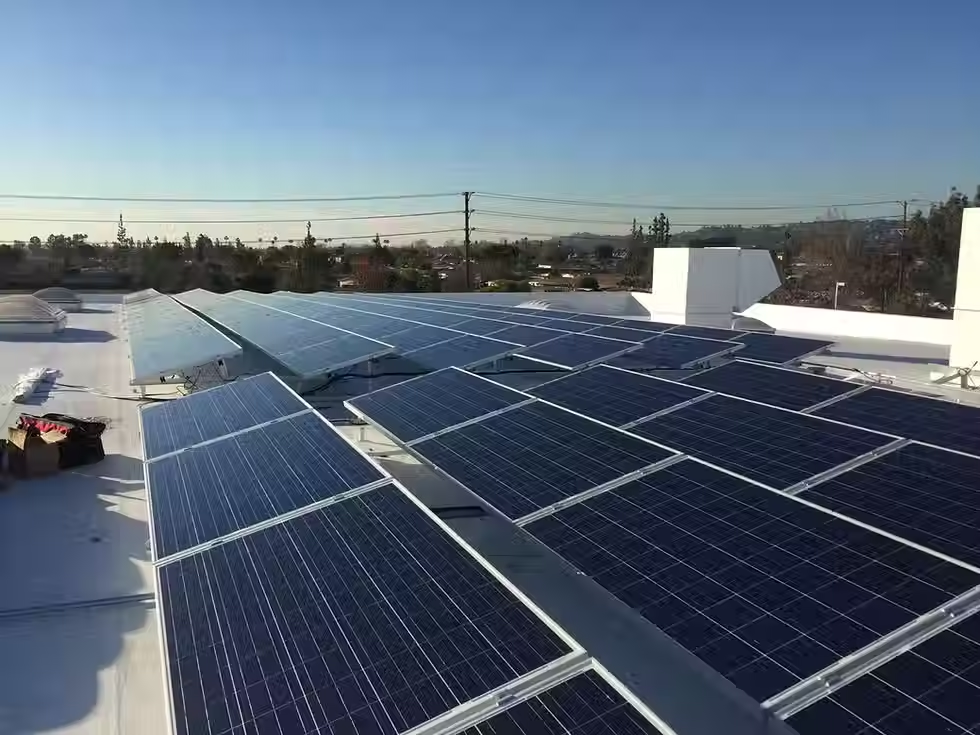
On residential roofs, 400–500 W solar watt panels can reduce the number of modules and simplify layout, but you must match panel dimensions to roof geometry and wind/snow load ratings. For commercial rooftops and carports, high‑watt modules increase generation per area; measure roof sections for shading, penetration points and access paths first.Inverters and optimisers must be sized for the higher module current and voltage; micro‑inverters may simplify mismatched roofs but can be more expensive per watt. Battery storage pairing requires checking continuous and peak charge rates—higher panel output can exceed battery charge controller limits during midday peaks.
Planning permits often require structural calculations for larger panels, and local building regulations may impose setbacks, access walkways or fire codes that affect layout. You should model expected annual yield with local solar irradiance data rather than relying solely on STC (standard test condition) wattage. For the best advice and installation of solar watt panels, consult Solar Panels London for tailored solutions that maximise your return and system performance.

For more solar insights, explore our blogs “300 Watt Solar Panel” and “Solar Panels 700 Watt” to compare panel performance, sizing, and installation considerations.
Installation and Safety Factors
Installers must follow updated safety protocols for higher open‑circuit voltages and short‑circuit currents when working with solar watt panels. Use DC rated isolation devices and appropriately sized PV combiner boxes to prevent overload; label arrays with accurate maximum system voltage and current for emergency responders. Solar Panels London recommends these precautions for all solar watt panels installations.
Working at height with larger solar watt panels increases manual handling risks—use team lifts, mechanical aids and module handling hooks. Grounding and bonding must meet local regulations; higher module currents may need thicker conductors and larger protective devices to maintain safe operating temperatures.
Thermal management and ventilation can affect hot‑spot formation on larger solar watt panels. Ensure manufacturer warranty covers potential hotspot-related degradation. Solar Panels London advises incorporating monitoring per string or module level to detect underperformance early and to verify that solar watt panels operate within inverter and battery specifications.


Comments