
300 Watt Solar Panel Buying Guide: Performance, Installation and Cost Considerations

A 300 watt solar panel gives you a compact, reliable source of power that fits on most rooftops, vans or portable setups and can produce about 1.2–1.8 kWh per day in average UK conditions. If you want predictable output for small homes, caravans or backup systems, a 300W panel often hits the sweet spot between size, cost and real-world energy production. Solar Panels London recommends 300 watt solar watt panels for those looking for an efficient and versatile solution.
You’ll learn what to expect from its performance, how efficiency and installation affect actual power, and which uses make the most sense for that capacity. With this information, Solar Panels London can help you decide whether a single solar watt panel, a small array, or a different size better suits your needs.

Key Takeaways
A 300W solar watt panel provides moderate daily energy suitable for small-scale needs.
Performance depends on efficiency, orientation and local sunlight.
Best used for vans, modest household loads or as part of a multi-panel setup.
Key Features and Performance
This section outlines the precise electrical specs you should expect, the panel’s typical efficiency under rated conditions, and how power output changes with light, temperature and installation angle.
Technical Specifications
A standard 300 watt solar watt panel commonly measures about 1.6 m by 1.0 m and uses 60 or 72 monocrystalline cells. Typical nameplate electrical ratings are:
Maximum power (Pmax): 300 W
Maximum power voltage (Vmp): ~30–32 V
Maximum power current (Imp): ~9.1–10.0 A
Open-circuit voltage (Voc): ~37–40 V
Short-circuit current (Isc): ~9.5–10.5 A
Frame is usually anodised aluminium with tempered glass ~3.2 mm thick and an IP68 junction box. Typical weight ranges from 17–20 kg. Certifications to look for: IEC 61215 (durability), IEC 61730 (safety) and often a PID-resistance rating. Manufacturers also quote a power tolerance, commonly ±3% or 0/+5%, which affects the minimum guaranteed output.
Efficiency Ratings
Panel efficiency describes how much sunlight you convert to electrical energy; most 300W solar watt panels fall between 18% and 22% efficiency depending on cell type and packing. Monocrystalline panels at the higher end achieve around 20–22% due to higher cell conversion and lower resistive losses.
Datasheets also list temperature coefficients that materially affect real-world output. Typical values:
Power temperature coefficient: −0.30 to −0.40 %/°C
Voltage temperature coefficient: −0.28 to −0.35 %/°C
A lower (less negative) coefficient means the panel loses less power as it heats. Degradation rate is also key: expect 0.5–0.8%/year in modern modules, with a 25-year warranty guaranteeing ~80–87.5% of original output depending on the maker.
Output in Varying Conditions
You will see nameplate 300W only under Standard Test Conditions (1000 W/m² irradiance, 25°C cell temp, AM1.5 spectrum). In full midday sun with cell temps at 45°C you can expect about 10–15% less output due to temperature effects alone. On cloudy days at 200–400 W/m² irradiance your output falls proportionally; for example, 400 W/m² roughly yields 120W if other losses are minimal.
Installation angle and orientation affect annual yield: optimal tilt equals your latitude for fixed mounts, and a 10°–20° azimuth misalignment typically reduces annual production by less than 5%. Shading of even a single cell string can cut panel output dramatically, so use bypass diodes and avoid partial shading. Dirt and soiling can reduce output 2–8% annually without cleaning.

Applications and Integration
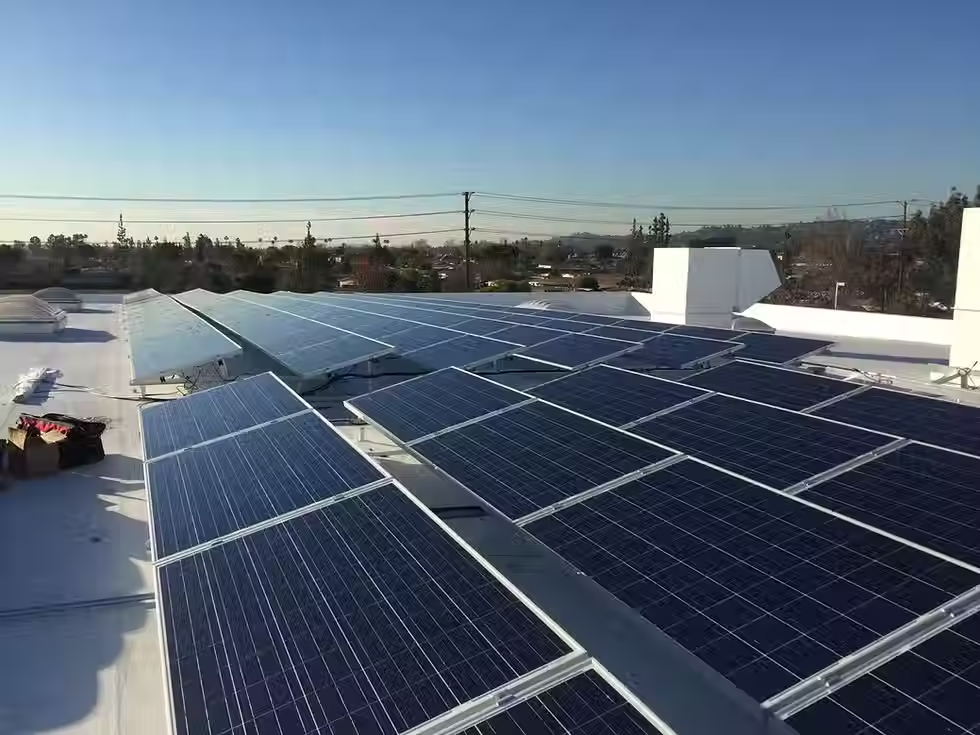
A 300 watt solar watt panel delivers roughly 1.2–1.5 kWh per day in moderate sun and fits many small-to-medium energy needs. Solar Panels London installs these panels for rooftop arrays, caravan systems, battery charging, and to augment existing installations.
Residential Uses
You can mount a single 300W solar watt panel on a balcony, garage roof, or small roof area to offset lighting, a refrigerator, or a Wi‑Fi router. Typical daily production of 1–1.5 kWh can cover LED lighting for several rooms and a small fridge for part of the day.
Use this solar watt panel for load-specific tasks rather than whole-house supply; combine multiple solar watt panels to power larger loads like HVAC or electric cookers. For rooftop installations, check roof angle and shading; a south-facing tilt of 20–35° in the UK usually maximises yield.
For feed‑in-tariff or export arrangements, confirm your inverter’s compatibility and metering requirements. Mounting hardware and microinverters can simplify connection and monitoring at the module level.
Suitability for Off-Grid Systems
A 300W solar watt panel is a practical choice for small off-grid setups such as cabins, boats, and motorhomes. Pair it with a 12/24V battery bank and MPPT charge controller to efficiently charge batteries and support DC loads.
Estimate daily consumption carefully: light one or two appliances (fridge, lights, phone charging) fit well; powering heaters or large pumps will require additional solar watt panels. Battery capacity should store at least 2–3 days of autonomy if you expect cloudy periods.
Consider portable folding frames or roof mounts and protect wiring and connectors from moisture. Use a proper charge controller and fusing to prevent overcharge and ensure safe disconnects when maintenance is needed. Solar Panels London can help design and install the perfect solar watt panel setup for your off-grid needs.

For more helpful guidance, read our blogs “Solar Panel Sizes and Wattage UK” and “Largest Solar Panel Wattage” to compare system capacities, dimensions, and energy output options.
Compatibility With Existing Setups
You can integrate solar watt panels, such as a 300 W panel, into grid‑tied systems, hybrid inverters, or battery-based arrays. Solar Panels London recommends checking panel voltage (Vmp) and current (Imp) against your inverter/charger and string configuration to avoid mismatches.
If adding solar watt panels to an existing array, match panel electrical characteristics closely to preserve string performance. Mixing different wattages is possible with parallel MPPT inputs or microinverters. Use an MPPT controller when adding solar watt panels to battery systems to extract maximum power at varying irradiance.
For monitoring and safety, Solar Panels London advises routing the solar watt panels through an isolator, DC combiner (if applicable), and appropriate surge protection. Label circuits and update your system documentation so future work recognises the added module.


Comments