
Solar Panels 700 Watt: High-Efficiency Options and System Planning Guide

If you need a compact, high-output solar option, 700-watt solar watt panels can deliver substantial power for off-grid systems, RVs, or to supplement a house supply. A single 700W solar watt panel typically produces significantly more energy than standard panels, letting you reduce the number of panels and simplify your installation. Solar Panels London offers a range of solar watt panels to suit various needs, ensuring you get the most efficient setup for your property.
You’ll learn what to expect in real-world performance, how physical size and mounting affect output, and which inverter and battery pairings work best. The following article will help you decide whether a 700W solar watt panel fits your system, budget, and space constraints.

Key Takeaways
A 700W solar watt panel offers higher per-panel energy output to lower panel count.
Performance depends on orientation, shading, and inverter compatibility.
Installation choices determine suitability for homes, vans, and off-grid kits.
Technical Specifications and Performance
You’ll find concrete figures for power output, physical size, electrical compatibility, and materials to judge whether a 700W solar watt panel fits your system. Key details include real-world efficiency, voltage/current characteristics, mounting weight limits, and expected degradation.
Typical Output and Efficiency
A 700W solar watt panel’s standard test condition (STC) rating denotes peak output at 1000 W/m² irradiance, 25°C cell temp, and AM1.5 spectrum. Expect 700W peak, but typical real-world midday output under good conditions more often sits around 560–630W due to temperature, angle, and shading losses.
Look for rated efficiency between about 20% and 24% for modern large-format mono PERC or n-type cells in a 700W class. Temperature coefficient commonly ranges −0.30% to −0.38%/°C, which means each 1°C rise above 25°C reduces output by that percentage. Check NOCT (usually 44±2°C) to estimate realistic daily yields.
Manufacturers also publish PERC, TOPCon, or heterojunction cell types; these affect how performance degrades over time. Typical first-year degradation is 1% or lower, with annual degradation around 0.4–0.6% for high-quality solar watt panels.
Panel Dimensions and Weight
A 700W solar watt panel uses larger cells or more cells in series/parallel, so expect physical dimensions roughly 2.2–2.4 m long and 1.1–1.2 m wide, though bifacial designs or half-cut variants can vary. Thickness usually sits between 30 and 40 mm including frame and junction box.
Weight commonly ranges from 30–38 kg for framed monofacial units; bifacial or reinforced panels can be heavier. Confirm weight per panel to ensure your roof or mounting structure supports the load; for example, 36 kg over 2.4 m² equals ~15 kg/m² plus wind/snow loads.
Check hole/slot patterns and frame profile for clamp and rail compatibility. Manufacturers provide detailed mechanical drawings with centre-of-gravity and lifting points—use these when planning handling and installation.
Voltage and Compatibility
A 700W solar watt panel typically has higher maximum power voltage (Vmp) around 38–48 V and open-circuit voltage (Voc) about 44–58 V, depending on cell configuration and temperature. Typical maximum power current (Imp) sits between 14–19 A for most designs.
These voltage/current ranges determine string sizing and inverter compatibility. For example, a 600 Vdc string inverter will allow up to about 10–12 panels in series if Voc at low temperature stays within limits. Alternatively, MPPT charge controllers for battery systems commonly accept 100–150 V or more; ensure Imp stays below controller current limits.
Bifacial panels may list separate rear-side performance gains of 5–25% depending on albedo; system designers must account for slightly different Vmp/Imp when modelling arrays. Always consult the panel’s IV curve and temperature coefficients when planning string layout.
Materials and Build Quality
High-wattage solar watt panels use large silicon wafers—mono PERC, TOPCon, or heterojunction—with anti-reflective coatings to boost absorption. Frames are usually anodised aluminium (6063-T5), offering good corrosion resistance and standardised 30–40 mm depth for clamps.
Glass is typically 3.2–4.0 mm tempered low-iron with AR coating; thicker glass and laminate layers increase durability but add weight. Bifacial variants use dual-glass construction to protect cells and improve rear-side yield; check IEC 61215/61730 certification for mechanical and safety standards.
Junction boxes commonly use IP68 rated enclosures with 3-5 mm2 MC4 or compatible connectors. Look for PID resistance, salt mist, and ammonia test certifications if you’re near coastlines or agricultural sites. Manufacturers often provide 12–25 year product warranties and 25–30 year performance warranties; read terms for linear degradation guarantees.

Practical Applications and Installation
700W solar watt panels suit systems that need high output per panel while saving roof or ground space. They work well for off-grid cabins, large on-grid arrays, battery-based backup, and commercial roofs where panel count or racking capacity is constrained. Solar Panels London can advise on the best way to integrate these solar watt panels into your home or business.
Residential and Commercial Uses
You can use a 700W solar watt panel to reduce the number of modules needed for a given kWh target. For example, a 7 kW rooftop system needs ten 700W solar watt panels instead of ~18–25 smaller panels, freeing roof space and lowering racking and labour costs. This is useful on steep, shaded, or architecturally constrained roofs.
In commercial installations, you often pair 700W solar watt panels with high-capacity string inverters or central inverters and MPPT optimisers to maintain performance under partial shading. They fit well on single-axis trackers and large flat roofs where weight per square metre and cable runs are key considerations.
You should consider planning for handling and transport: panels near 100 kg require at least two people or mechanical lifts. Also check local building codes and load limits, because larger modules concentrate weight and wind load differently than smaller modules.
Installation Requirements
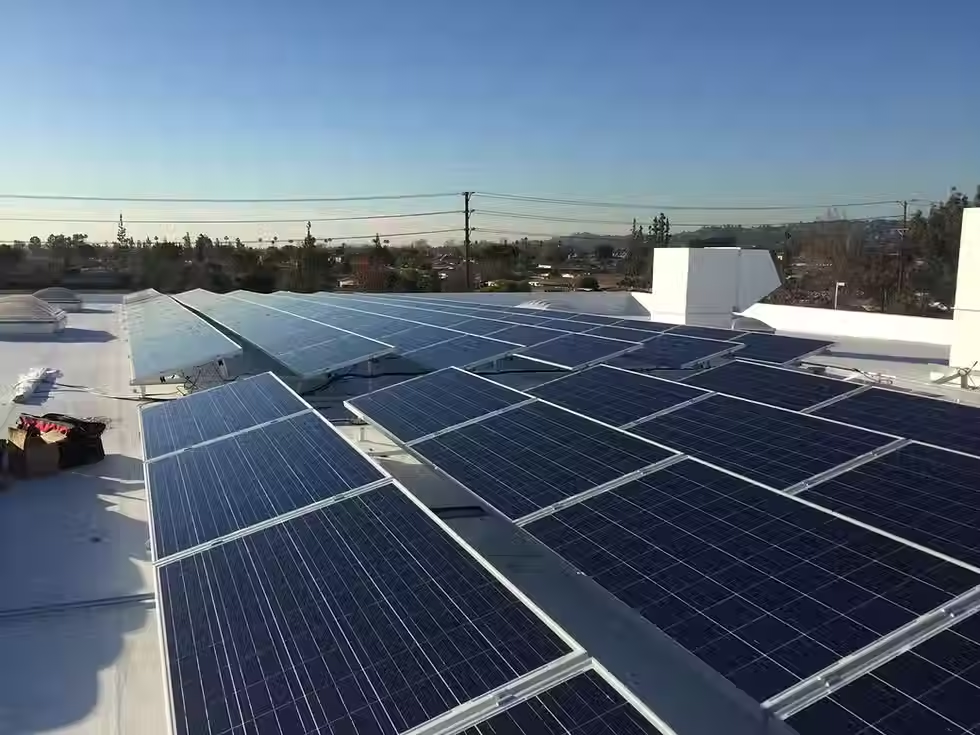
You must confirm rooftop area, orientation, and tilt before selecting 700W solar watt panels. Typical 700W glass-backsheet or bifacial modules measure roughly 2.3–2.5 m by 1.1–1.2 m; you need enough continuous unobstructed length for each row. Measure roof obstructions, chimney setbacks, and ventilation clearances to avoid last‑minute redesigns.
Electrical design needs appropriate inverter matching and string length calculations. With higher module wattage, keep string voltages within inverter Vmax and MPPT limits. Use suitably rated cables and overcurrent protection; expect higher short-circuit currents, so size fuses and DC isolators accordingly.
Plan for lifting, handling, and PPE. Check manufacturer torque specs for mounting clips and follow solar installer association guidelines for wind uplift and fire classification. Obtain electrical inspection and building permits before installing.
Solar Panels London can help you select, install, and maintain your 700W solar watt panels, ensuring optimal performance and longevity for your investment. Whether for home or business, Solar Panels London is your partner in efficient solar energy solutions using advanced solar watt panels.

For more guidance, read our blogs “Largest Solar Panel Wattage” and “Solar Watt Panels Cost” to compare panel capacities, pricing, and system design considerations.
Mounting Options
You can mount 700 W solar watt panels on pitched roofs using reinforced rails designed for longer modules. Solar Panels London recommends choosing rail spans and mid‑clamps rated for the panel length and weight; longer unsupported spans increase deflection risk. Use tilt brackets if orientation needs correction.
Flat roofs work well with ballast or low‑profile tilt racks; ensure ballast calculations account for wind uplift on larger solar watt panels. On ground‑mount or tracker systems, use foundation designs that support wider module rows and heavier cantilevers. Trackers require foundations sized for dynamic loads.
For carports and canopies, verify clearance heights and structural loading; larger solar watt panels create bigger wind loads and require stronger posts and crossbeams. In all mounting types, Solar Panels London advises keeping wiring runs short, planning conduit sizing, and installing junction boxes for accessible maintenance of your solar watt panels.


Comments