
Solar Panel for Businesses: Maximising Savings and Sustainability

Installing solar panels can cut your energy bills and make your business more resilient to price spikes without disrupting daily operations. You can expect predictable savings, lower carbon exposure and a strong return on investment when you choose the right system for your site and energy use.
This post walks you through the options, costs and practical steps so you can decide whether to buy, lease or use a power purchase agreement. You will learn what to check on roofs, permissions and incentives, and how to compare installers to protect your bottom line.
Key Takeaways
Solar can reduce operating costs and improve financial predictability for your business.
Choosing the right system type and contract determines long-term value and performance.
Practical site checks and installer comparisons speed up implementation and reduce risk.
Benefits of Solar Panels for Businesses UK
Solar panels for businesses UK can cut your electricity bills, reduce your carbon footprint, and improve stakeholder perceptions. They provide predictable energy costs, tangible sustainability metrics, and visible proof of environmental commitment.

Cost Savings and Energy Independence
Installing solar panels for businesses UK lowers your operational costs by generating on-site electricity and reducing grid consumption. Businesses typically offset 30–80% of their daytime consumption depending on system size and rooftop availability. Feed-in tariffs or export credits can provide additional revenue for exported power, though rates vary by location and contract.
Solar paired with battery storage increases resilience. Storage lets you shift self-consumption to evenings, reduce peak-demand charges, and maintain critical loads during outages. Calculate payback using realistic load profiles, system degradation (around 0.5%–1% per year), and local incentives to estimate a 5–12 year payback in many UK commercial cases.
Environmental Impact and Sustainability
Solar panels for businesses UK directly reduce Scope 2 emissions by replacing grid electricity with low-carbon generation. For a typical 100 kW rooftop array, you can avoid roughly 30–45 tonnes of CO2 annually depending on grid carbon intensity.
Using PV also supports lifecycle sustainability goals when you select accredited modules and recycling pathways. Choose panels with clear product stewardship, third-party performance guarantees, and supplier transparency on material sourcing to minimise embodied carbon and manage end-of-life impacts.
Enhancing Corporate Image
Visible solar installations signal operational responsibility to customers, investors, and employees. You can quantify benefits in sustainability reports, displaying metrics such as kWh produced, CO2 avoided, and percentage of on-site demand met by solar.
Marketing tangible benefits works alongside workplace culture gains. Solar projects often boost employee pride and can be integrated into customer tours, signage, or digital dashboards to demonstrate action rather than intent.
Types of Solar Panel Systems for Commercial Use
You’ll find three practical ways to deploy commercial solar: on building roofs, on open ground, and as sheltered parking structures. Each option differs in installation complexity, energy yield per square metre, and potential to free up usable space.
Rooftop Solar Installations
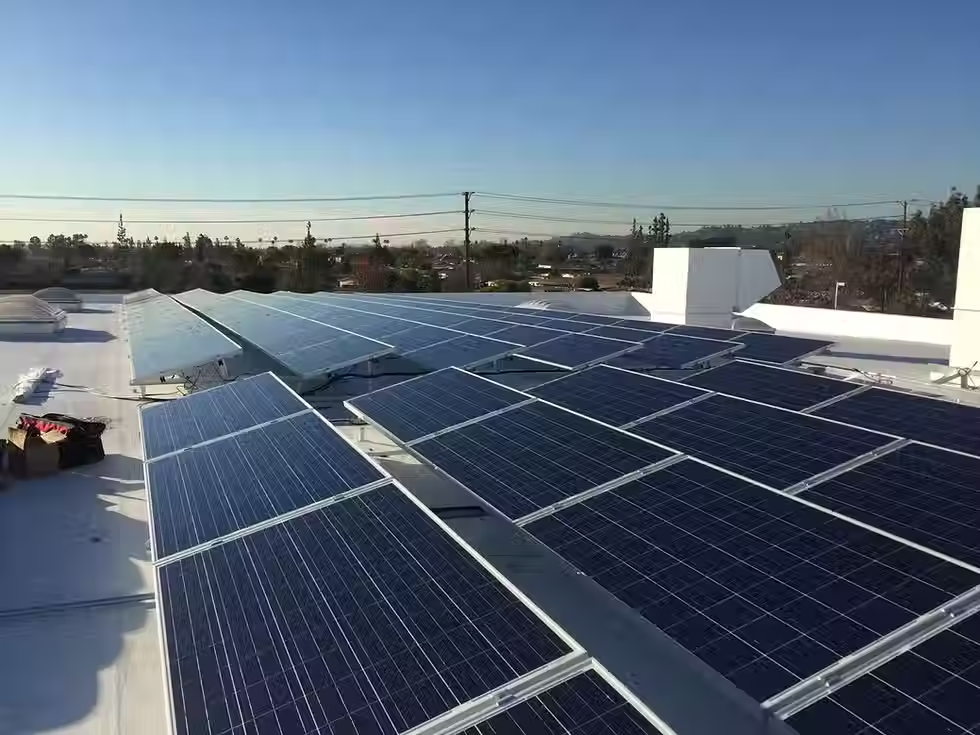
Rooftop systems attach solar arrays directly to your building’s roof—flat or pitched—and are typically the fastest to install. They make use of otherwise unused space, minimise land costs, and reduce transmission losses because generation sits at the point of consumption.
Key considerations:
Structural assessment: You must check roof load capacity and remaining lifespan; lightweight framed panels and ballast mounts often suit flat roofs.
Orientation and tilt: South-facing roofs (in the UK) with a 10–30° tilt deliver higher yields; microinverters or optimisers help with shading issues from HVAC or neighbouring structures.
Access and maintenance: Install walkways or use panel spacing to allow safe maintenance and snow/leaf clearance.
Regulatory and warranty impacts: Ensure roof penetrations don’t void membrane warranties and confirm planning permission if panels are visible from the street.
Ground-Mounted Solar Solutions
Ground-mounted systems sit on steel or aluminium frames anchored to piles or concrete. They suit large sites where roof area is insufficient, enabling larger arrays and easier orientation optimisation for maximum energy capture by the solar panels for businesses UK.
Decisions you’ll make:
Fixed-tilt vs tracking: Fixed-tilt systems are cheaper; single-axis trackers raise annual yield by ~15–25% but add moving parts and maintenance.
Site preparation: Grading, drainage and fencing may be required; consider biodiversity plans and soil impact assessments.
Electrical layout: Central inverters scale well for large arrays, but string inverters with monitoring can improve fault detection.
Security and grid connection: You’ll need perimeter security, earthing systems and a high-capacity grid connection point; connection costs can dominate project budgets.

Solar Carports
Solar carports mount panels above parking areas, delivering dual value: power generation plus sheltered parking for staff or customers. They integrate with EV charging and can offset lighting and HVAC loads for adjacent buildings.
Practical points:
Design variants: Single-row, double-row or canopy systems adapt to lot size; modular designs simplify phased roll-outs.
Structural requirements: Foundations must handle wind uplift and snow loads; steel columns must align with parking layouts to preserve usable bays.
Ancillary systems: Pair carports with on-site EV chargers, energy storage and smart metering to maximise onsite consumption.
Permitting and user experience: Carports often require planning consent; include lighting, drainage and accessibility in the design to maintain compliance and user satisfaction.
Key Considerations for Business Solar Installations
Assess financial support, site suitability and your ongoing operational needs before committing to a system. Each factor strongly influences payback period, system size and long-term performance of your solar panels for businesses Uk.
Financial Incentives and Government Schemes
Identify available grants, tax reliefs and feed-in tariff or export tariff arrangements that apply to your business location and sector. Check national schemes such as the UK’s Enhanced Capital Allowances or Business Rates discounts, plus any local council grants or clean-energy loans.
Calculate the effect on cash flow: list upfront capital cost, projected annual energy savings, expected export income, and the accelerated depreciation or tax deductions. Use a simple payback and an internal rate of return (IRR) to compare options. Include VAT recovery rules for commercial installations and whether lease or power purchase agreement (PPA) structures shift capital requirements.
Confirm eligibility requirements and application timelines. Many schemes require pre-approval, MCS certification for installers, or accredited meter installation. Keep a spreadsheet of deadlines, required documentation and contact details for scheme administrators.
Site Assessment and Energy Needs Analysis
Measure usable roof or ground space precisely; record orientation, tilt, shading and structural capacity in kN/m². Use satellite imagery plus an on-site survey to verify available area and unobstructed sun hours across seasons. Account for planning restrictions if the building is listed or in a conservation area.
Compile 12–24 months of half-hourly electricity usage from bills or your smart meter to model load profile and peak demand. Determine the proportion of on-site consumption vs export; this drives inverter sizing, battery needs and whether demand-side management or load-shifting will increase self-consumption.
Factor roof age, fire rating, access for maintenance and potential future expansions like EV chargers. Produce a schematic showing array layout, inverter position and cable routes to avoid surprises during installation and ensure compliance with Building Regulations and electrical standards.
Maintenance and Operational Requirements
Plan for periodic cleaning, inverter checks and thermal imaging inspections to catch hotspots early. Establish a maintenance schedule: visual inspections quarterly, inverter servicing annually, and detailed electrical tests every 3–5 years. Assign responsibility — in-house facilities or contracted O&M provider — and record service intervals.
Monitor system performance in real time with a metering and SCADA setup that alerts you to underperformance or faults. Set KPIs such as expected monthly generation, availability >98% and time-to-repair targets. Keep spare parts inventory for critical components like inverters or string fuses when immediate replacement matters.
Prepare for warranty and insurance management: register manufacturer warranties, track performance guarantees, and update property and business interruption insurance to cover system damage and loss of generation. Document procedures for grid outages, export limits and interaction with any battery storage systems.
Steps to Implement Solar Panels for Businesses UK
Plan site assessment, financing, permissions, installation and ongoing monitoring to match production to your peak loads and financial goals. Focus on accurate energy data, realistic payback estimates and a trusted installer with commercial experience to install solar panels for businesses UK.

Choosing a Reliable Solar Provider
Select a provider with proven commercial installations and verifiable references from businesses similar in size and sector to yours. Ask for case studies showing system size (kW), annual yield (kWh), and achieved savings; request contact details for at least three recent clients.
Verify certifications and warranties: ensure panels and inverters carry manufacturer warranties (typically 10–25 years) and the installer offers a workmanship guarantee. Confirm the installer is accredited by a recognised body (for example MCS in the UK) and holds adequate public liability and employer’s liability insurance.
Compare detailed proposals, not just headline price. Each proposal should include a site layout, expected annual generation, degradation assumptions, estimated export/import profile, equipment spec sheets and a timeline. Negotiate payment terms and retain a clause for performance validation after commissioning.
For region-specific insights, explore our guide on Commercial solar panels UK to see how businesses are benefiting locally.
Navigating Planning Permissions and Regulations
Check local planning rules and building regulations early; many rooftop commercial installs are permitted development, but listed buildings or conservation areas often need planning permission. Contact your local planning authority with roof plans and elevation drawings if in doubt.
Assess structural suitability: commission a structural engineer to confirm roof loading capacity and recommend strengthening if required. Provide the engineer with panel weights, mounting details and worst-case wind uplift calculations.
Understand grid connection and export rules. Apply to your Distribution Network Operator (DNO) for connection agreement if your export or import arrangements exceed standard limits. Ensure your proposal includes the necessary export meter, anti-islanding protection and any required distribution network reinforcement costs.
For expert guidance and installation of solar panels for businesses UK, consider working with Solar panels London. Solar panels London offers tailored solutions to maximise your savings and sustainability while ensuring compliance and reliability. Choosing Solar panels London for your commercial solar project ensures you benefit from local expertise in solar panels for businesses UK, from site assessment to ongoing maintenance.
Monitoring Performance and Maximising Return on Investment
Install a real-time monitoring system that reports production (kW/kWh), system status and inverter alerts to both you and the installer. Use dashboards with export data and consumption matching so you can shift high-demand processes into peak production periods with Solar panels for businesses UK. Solar panels London recommends implementing demand-side measures: add timers, thermal stores, or battery storage to increase self-consumption and reduce peak tariffs.
Calculate the marginal value of storage versus exporting by modelling tariff periods, demand profiles and storage round-trip efficiency. Solar panels London advises scheduling regular preventative maintenance: clean arrays as suited to your site (frequency depends on dust and bird activity) and perform inverter checks per manufacturer guidance. Keep production records and compare actual yield to the original performance estimate; pursue warranty or performance claims promptly if variance exceeds agreed thresholds. Solar panels for businesses UK can help ensure you maximise your return on investment with ongoing support and advice. For businesses considering Solar panels for businesses UK, Solar panels London offers tailored solutions and monitoring systems to optimise your energy savings.


Comments