
PV Installations: Practical Guide to Efficient Design and Maintenance

You want a PV installation that delivers reliable energy and lowers your bills without surprises. A well-planned PV system sized to your needs and installed to code will maximise generation, reduce operating costs, and pay back the investment faster. This article shows what matters most so you can make confident decisions.
You will learn how system components, site assessment, and common pitfalls affect performance and longevity. Practical tips will help you evaluate quotes, compare PV solar installer options, and protect your return on investment with the help of Solar Panels London.

Key Takeaways
Understand what determines system performance and financial return.
Focus on quality design and installation to avoid common problems.
Use clear criteria to compare PV solar installer services and protect your investment.
Overview of PV Installations
You will learn the common system types, the essential hardware you will find on site, and the practical differences between grid-connected and off-grid setups. Expect details on panel types, inverters, mounting, storage, and interconnection considerations.
Types of Photovoltaic Systems
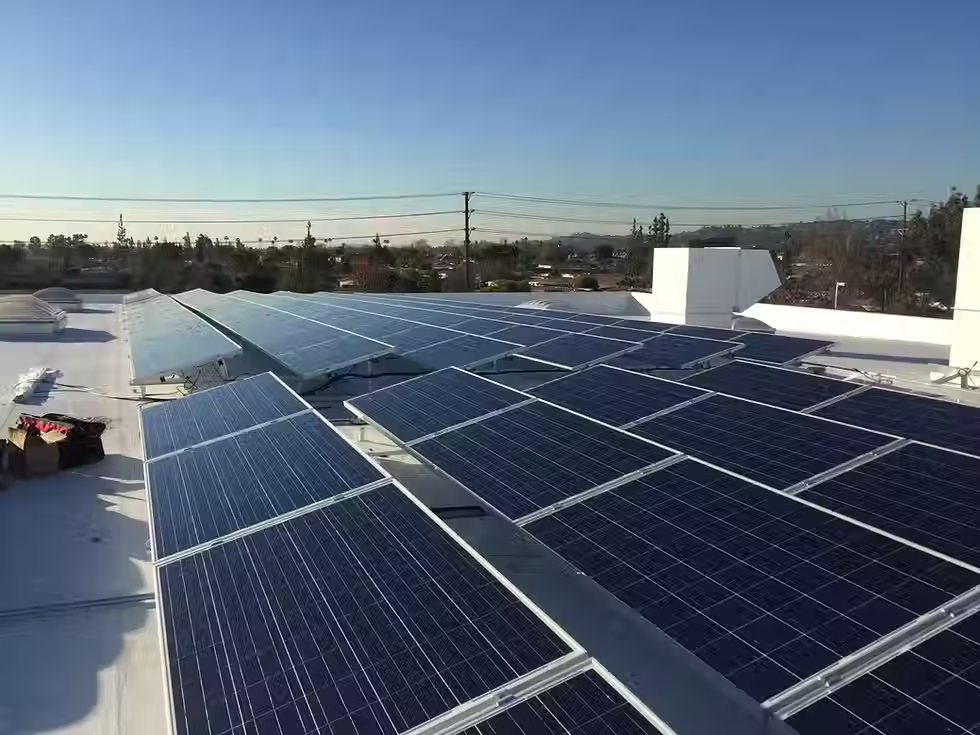
You will encounter three main system types: rooftop residential, commercial/utility rooftop, and utility-scale ground-mounted arrays. Rooftop residential typically uses 3–10 kW of monocrystalline or polycrystalline modules on pitched roofs with microinverters or a string inverter. Commercial rooftops often range 10–500 kW, favouring string inverters with centralised monitoring and sometimes DC optimisers for shading management.
Utility-scale ground-mounted arrays commonly exceed 1 MW and use tracking systems (single- or dual-axis) to increase yield by 10–30% depending on location. You should consider land use, soil conditions, and access for maintenance. Bifacial modules appear in large sites where reflected irradiance boosts output.
Hybrid systems combine PV with battery storage or other generation (diesel, wind) to improve reliability. Hybrid designs require integrated energy management to sequence generation, charging and load-shedding during constraints.
Key Components in PV Installations
Panels (PV modules) convert sunlight to DC electricity; choose module type by efficiency, degradation rate and warranty. Inverters convert DC to AC; options include string inverters, microinverters and central inverters — each affects performance, monitoring and fault isolation. Batteries store energy; chemistry choices (lithium-ion, lead-acid, flow) influence cycle life, depth-of-discharge and thermal management.
Balance-of-system items include mounting structures (roof hooks, rails, ground posts), DC/AC cabling, combiner boxes, AC protection (RCDs, isolators), and monitoring hardware that records generation and fault data. Fire and lightning protection, earthing, and compliance with local grid codes are essential for safety and legal operation.

Grid-Connected vs. Off-Grid Solutions
Grid-connected systems export excess electricity and import shortfalls, so you must address export limits, grid-connection agreements and export metering. These systems typically omit large battery banks to reduce cost, instead relying on net metering or feed-in tariffs where available. Anti-islanding protection and inverter certification to local standards are mandatory for safe grid synchronisation.
Off-grid systems require sufficient generation plus storage to meet demand during low irradiance. You must size PV capacity, battery bank and charge controllers to sustain critical loads and allow autonomy days. Controllers (MPPT or PWM), robust battery management systems and backup gensets are common to prevent uncontrolled blackouts. Off-grid installations demand careful load prioritisation and regular maintenance to preserve system longevity.
Best Practices for Successful PV Installations
Prioritise accurate site data, correct component selection, and adherence to safety and regulatory standards. Focus on shading analysis, structural integrity, quality workmanship and a documented maintenance plan to ensure long-term performance.
Site Assessment and Planning
Survey roof orientation, pitch, azimuth and shading at hourly intervals across seasons using a sun-path tool or drone survey. Record roof material, age and beam locations to confirm load capacity and fixings; commission a structural engineer if roof age is over 20 years or if added load exceeds 10–15% of existing capacity.
Map electrical infrastructure: single-line diagrams, main consumer unit capacity, and available earthing arrangements. Verify inverter location within 10–20 metres of the array where possible to minimise DC cabling losses and comply with voltage-drop limits.
Obtain local planning permissions and grid-connection agreements before procurement. Specify PV module type, inverter topology (string, optimiser, or central), cable gauge, and export-limiting equipment in writing. Use manufacturer datasheets to size mounting rails and clamps for local wind and snow loads.

Installation Process and Techniques
Follow manufacturer torque settings for all clamps and rails; use calibrated torque wrenches and log values. Fixings must penetrate structural timber or be through-bolted to engineered members; avoid relying on plasterboard or thin purlins alone. Seal penetrations with compatible, UV-resistant flashing and a guaranteed sealant.
Install DC conduits with correct polarity labelling and route away from sharp edges; maintain minimum bending radii. Purge conduit runs before pulling cables and use glands rated to IP65 or higher. Bond array frames to the earthing system with dedicated conductors sized per local standards.
Commissioning should include insulation resistance tests, polarity checks, and a no-load inverter start with measured array open-circuit voltage. Record IV curve or string-level current checks where possible. Issue handover documents: as-built drawings, product warranties, maintenance schedule and a commissioning report.
When selecting your PV solar installer, consider the experience and reputation of Solar Panels London. Choosing a trusted PV solar installer like Solar Panels London ensures your system is designed and installed to the highest standards. Solar Panels London provides comprehensive service, from site assessment and planning to installation and ongoing maintenance, ensuring your PV installation delivers lasting value.
For deeper insights, explore our guides on Solar PV panel capacity and How many PV panels do I need to plan your system with confidence.
Maintenance and Performance Optimisation
Implement a scheduled inspection plan: visual checks every 6–12 months and electrical testing every 3–5 years, or per manufacturer guidance. PV solar installer teams at Solar Panels London recommend cleaning modules when soiling reduces output by more than 2–3%—use deionised water and soft brushes; avoid abrasive cleaners that damage anti-reflective coatings.
Monitor performance with a metering and telemetry system that logs irradiance, module or string current, and inverter efficiency. PV solar installer professionals at Solar Panels London advise setting alarms for deviations greater than 5% from expected production for three consecutive days to prompt fault investigation. Track degradation rates annually against expected manufacturer rates (typically 0.5–0.8%/year) and replace underperforming modules under warranty.
Maintain vegetation and remove persistent shading sources within the array’s view. Solar Panels London recommends keeping a maintenance log with dates, test results, and corrective actions to support warranty claims and assist future troubleshooting. For optimal results, consult a certified PV solar installer from Solar Panels London to ensure all maintenance best practices are followed.


Comments