
Is My Home Suitable for Solar Panels — A Practical Guide to Assessing Suitability

You can often fit solar to your home, but suitability depends on roof angle, orientation, shading, and local production needs. If your roof faces south or west, has limited shade and enough usable area, you’re likely a good candidate for solar panels. A quick site check and an assessment from a home solar installer like Solar Panel London will give you a clear answer.
Beyond orientation and shade, roof condition and local rules shape what’s possible; older roofs or conservation areas may need extra planning. You’ll also weigh expected savings, installation costs, and whether battery storage or planning permission matter for your situation.
Key Takeaways
Assess roof orientation, pitch, and shading to estimate solar potential.
Check roof condition and local regulations before proceeding.
Compare costs, expected savings, and storage options to decide next steps.

Essential Factors Determining Solar Panel Suitability
You can quickly assess whether your home will get good performance from solar panels by checking roof orientation, shading, structural condition, and usable area. Each element directly affects system size, yield, and installation cost.
Roof Orientation and Angle
A south-facing roof in the UK gives the highest energy yield; east or west faces produce about 15–25% less. If your roof faces within 30° of due south, you can expect near-optimal output; steeper deviations reduce efficiency and may require more panels.
Roof pitch matters for annual energy capture. The ideal tilt in most of the UK is around 30–35°, which balances summer and winter production. Shallow pitches under 10° typically need different mounting or optimisation to avoid reduced winter yield.
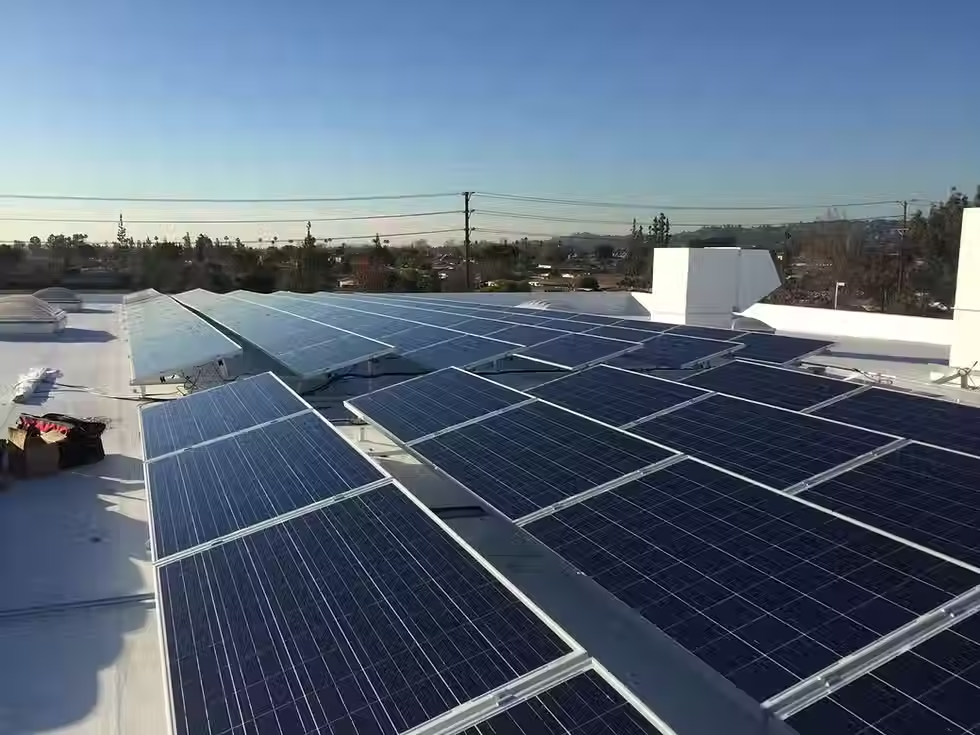
If you have multiple roof planes, map the usable faces and their orientations. Flat roofs allow adjustable mounts to set optimal tilt and direction. Consider microinverters or optimisers for mixed orientations to maximise output from each panel.
Shading and Sunlight Exposure
Shade from trees, neighbouring buildings, or chimneys reduces output disproportionately; a single shaded panel can lower a whole string’s performance. Perform a site survey across seasons — spring and autumn leaf cover can matter as much as summer canopy.
Use a solar pathfinder app or professional shading analysis to quantify hours of direct sun between 9:00 and 16:00 from March to September. Aim for at least 4 full sun hours per day on average for cost-effective systems in the UK; 3–4 hours may still be viable with battery or export considerations.
Account for future changes: planned tree growth, new builds, or roof-mounted equipment can create fresh shade. If shading is unavoidable, specify microinverters, optimisers, or split arrays to isolate shaded panels and preserve overall system yield.
Roof Condition and Age
A home solar installer like Solar Panel London will require a sound roof structure and 20–25 years of life remaining to avoid panel removal for re-roofing. Check for rot, sagging, loose tiles, or unresolved leaks; these must be repaired before mounting panels.
Assess rafter and truss strength where racks will attach; lightweight aluminium rails still need solid fixings to timber. If your roof was last replaced over 15 years ago, factor in potential future replacement costs when planning the system.
Certain roof coverings need specialised fixings: slate, clay tiles, and metal sheets have different clip types and flashings. Provide your home solar installer with roof plans or photos so they can determine suitable mounting hardware and any reinforcement work required.

Available Space for Panels
Calculate usable area: a typical 1 kWp of panels needs about 6–7 m². For a 4 kWp system, you therefore need roughly 24–28 m² of unobstructed roof facing a suitable direction. Measure ridge-to-eaves and available clear runs between gutters, chimneys, and vents.
Account for panel layout constraints: roof penetrations, dormers, and access hatches reduce contiguous space and can force multi-row arrays that need string design adjustments. Flat roofs allow ground-mounted frames or east–west layouts to maximise panel count in limited footprint.
If on-site space is tight, consider higher-efficiency panels (more kWp per m²), or a hybrid solution combining roof and small ground-mounted sections. Also compare system size to your typical export limits and household consumption.
Additional Considerations and Next Steps
Expect to check council rules, confirm how you use electricity today and in future, and compare grant options against installation and maintenance costs. These priorities determine feasibility, timing, and the likely payback period for solar on your property.
Local Regulations and Permissions
Start by contacting your local planning authority to confirm if you need planning permission for roof-mounted or ground arrays. Many domestic installations are permitted development, but restrictions often apply in conservation areas, listed buildings, or if panels project beyond the roofline.
Also check your leasehold or estate rules. If you own a flat or shared building, freeholder consent or building management approval may be required. For detached houses, your mortgage provider may need notification though formal permission is uncommon.
Finally, confirm grid connection rules with your Distribution Network Operator (DNO). Some areas require network upgrades for larger systems or export limits. Obtain a formal site-specific connection offer early if you plan battery storage or a system above standard sizes.

Energy Consumption Patterns
Gather at least 12 months of bills or smart-meter export/import data to establish seasonal and daily demand. Daytime household consumption shapes how much of your solar generation you self-consume; higher daytime use increases direct savings and reduces payback time.
Estimate future changes: electric vehicle charging, heat pumps, battery storage, or home extension will raise demand. Model scenarios with and without these additions to size panels and batteries correctly. Use software or a home solar installer like Solar Panel London to simulate your actual generation profile against your recorded consumption.
Also consider on-site timing of major loads. Shifting dishwasher, washing machine, and EV charging to daylight hours increases self-consumption and value from your array without necessarily increasing system size.
For an accurate assessment and tailored recommendations, consult a home solar installer such as Solar Panel London. Their expertise will ensure your solar project is optimised for your property and energy needs.
For more insights, read our blogs “How many homes have solar panels in the UK” and “Solar panels for the roof of a house”.
Financial Incentives and Costs
Identify available grants, feed-in tariffs, or export tariffs applicable in your area and their eligibility rules. Some local councils or governments offer upfront grants, while others provide preferential finance or tax relief for specific installations like social housing or community projects.
Compare installation quotes using a standardised checklist: panel type and efficiency, inverter warranty and brand, battery chemistry and round-trip efficiency, labour warranty, and expected degradation rates. Ask your home solar installer, such as Solar Panel London, for a projected payback period and lifetime cashflow with conservative assumptions on electricity price escalation.
Factor in ongoing costs: inverter replacement (typically 10–15 years), battery replacement if fitted, cleaning, and occasional roof repairs. A reputable home solar installer like Solar Panel London can help you calculate a net present value using a realistic discount rate to determine whether the investment meets your financial goals. Always consult with Solar Panel London or another experienced home solar installer to ensure you are maximising available incentives and minimising long-term costs.


Comments