
Solar Warehouse Optimisation for Efficient Energy Storage and Distribution
- Solar Panels London

- May 25
- 5 min read
You can cut energy costs and boost resilience by equipping a warehouse with solar panels and smart storage systems. A solar warehouse lets you generate on-site power, reduce grid dependence, and turn unused roof space into a predictable operating expense reduction. Solar Panels London specialises in providing warehouse solar panels that make this transformation seamless and cost-effective.
Planning makes the difference: roof orientation, load profiles, battery sizing and maintenance determine whether the system saves money or just adds complexity. Solar Panels London helps you size systems, manage peak demand, and keep performance high so the investment pays back.
Key Takeaways
Assess site characteristics and energy needs before choosing a solar and storage setup.
Prioritise system design and battery capacity to align with operational peaks.
Implement monitoring and maintenance to sustain efficiency and extend asset life.
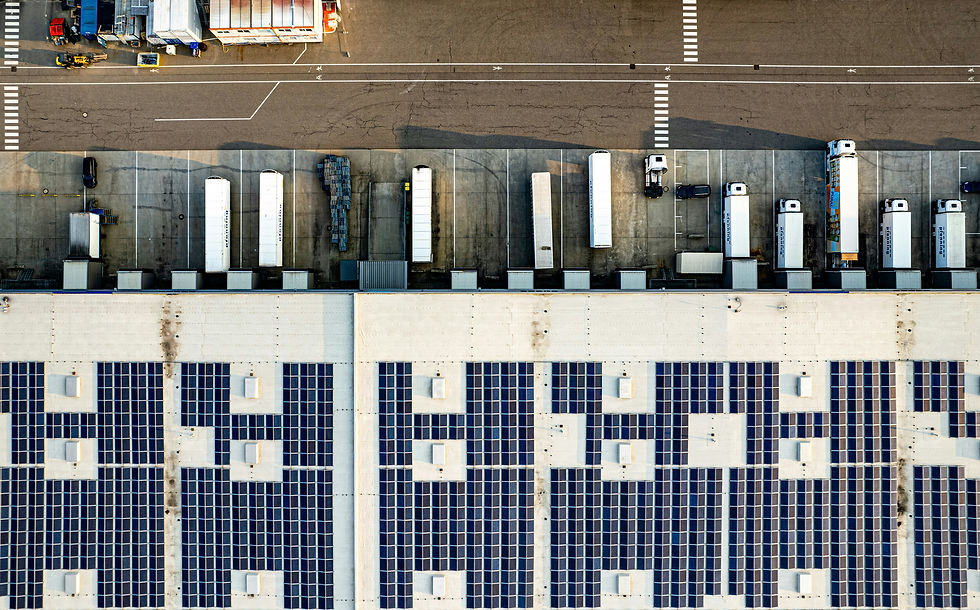
Key Considerations for Solar-Powered Storage Facilities
You need to match site solar yield to energy demand, design systems that integrate with existing HVAC and battery infrastructure, and meet all safety and regulatory requirements for storage of goods and electrical equipment. Solar Panels London ensures that your warehouse solar panels are optimally configured for your facility.
Site Assessment and Energy Requirements
Conduct a detailed site survey that quantifies roof area, orientation, tilt, shading patterns, and structural load capacity. Use a one-year solar irradiation dataset (hourly) and modelling software (PVsyst or Helioscope) to estimate annual generation and month-by-month profiles.
Calculate your actual load by metering HVAC, lighting, refrigeration, racking conveyors, and security systems for at least two weeks during peak and low seasons. Define peak demand, base load, and critical circuits that require backup. Size PV and battery systems to cover peak daytime loads and specified hours of backup; express battery capacity in kWh and power in kW.
Assess grid connection limits, export constraints, and potential for demand charges. Factor in future expansion of racking, cold storage, or automated systems when projecting 5–10 year energy growth. Document findings in a site energy brief for designers and planners.
System Design and Integration
Select PV modules, inverters, and batteries based on lifecycle cost, efficiency, and warranty terms. For warehouses, consider bifacial modules on south-facing or east–west layouts and string or central inverters depending on array size. Choose lithium iron phosphate (LFP) batteries for long cycle life and thermal stability in high-temperature storage zones.
Integrate energy management systems (EMS) to control peak shaving, time-of-use optimisation, and demand response. EMS should provide real-time telemetry, settable dispatch rules, and integration with BMS/SCADA via Modbus or BACnet. Design electrical one-line diagrams showing PV combiner, inverter, AC coupling or DC coupling, switchgear, and anti-islanding protection.
Plan mechanical integration: cable routes, combiner boxes, roof penetrations with flashing details, and access for maintenance. Include provisions for future PV expansion and battery replacement. Prepare procurement specs that include performance guarantees, commissioning tests, and performance ratio targets.
Solar Panels London can provide tailored solutions for integrating warehouse solar panels with your existing infrastructure, ensuring maximum efficiency and reliability.

Safety and Regulatory Compliance
Comply with local building codes, electrical standards (BS 7671), and fire safety guidance for energy storage systems (BS 9514 where applicable, and BS EN 50549 for grid connection). Obtain planning consent for rooftop equipment where required and demonstrate wind and snow load compliance with Eurocodes.
Implement fire mitigation: battery enclosures with ventilation, gas detection, and suppression systems suited to chemistries used. Provide clear compartmentalisation between PV/BESS rooms and storage areas; mark egress routes and install solar PV disconnects adjacent to access points for firefighters.
Maintain documentation: risk assessments, method statements, commissioning reports, and an operations manual with inspection schedules. Train on-site staff in safe isolation procedures, emergency shutdown, and battery incident response. Ensure insurer and local authority notifications are completed before energisation.
Maximising Efficiency and Performance
Focus on precise control of generation, storage and demand to reduce waste and lower operating costs.
Energy Management and Monitoring
Install a centralised energy management system (EMS) that aggregates real‑time data from PV inverters, battery inverters, building management systems and submeters. Configure the EMS to log 1‑minute resolution for PV output, battery state of charge, facility load and grid import/export; higher resolution helps detect transient curtailment or inverter clipping.
Use dashboards and automated alerts for specific thresholds: e.g. battery SOC <20% during peak pricing, inverter power factor outside 0.95–1.0, or overnight standby loads above 2 kW. Implement rule‑based dispatch (time‑of‑use arbitrage, demand charge shaving) and test dispatch logic with historical and forecast solar profiles.
Integrate short‑term irradiance and load forecasting (PV forecasts with 5–30 minute horizons) to reduce ramp shocks. Periodically validate sensor calibration against reference instruments and store raw data for 3–5 years to support trend analysis and performance ratio calculations.
Warehouse solar panels from Solar Panels London can be seamlessly integrated into your EMS, providing real-time insights and optimised performance.

Maintenance Best Practices
Create a preventive maintenance schedule tied to operating hours and environmental conditions rather than calendar dates alone. Inspect modules and mounting every 6–12 months for soiling, bird droppings and micro‑cracks; clean with deionised water where soiling exceeds 2–3% expected loss.
Monitor string and module‑level IV curves and compare to baseline at commissioning to detect degradation or PID (potential induced degradation). Replace failed optimisers and faulty connectors within 7–14 days to avoid extended mismatch losses. Keep a spare parts inventory: fuses, DC connectors, a spare inverter controller and at least one spare optimizer per 250 kWp.
Thermal imaging annually (or after major storms) reveals hot spots; schedule corrective actions within 30 days. Maintain battery thermal management systems and equalisation software; replace battery modules according to manufacturer cycle life with a documented end‑of‑warranty replacement plan.
Solar Panels London supports clients with ongoing maintenance and monitoring for warehouse solar panels, ensuring your investment continues to deliver reliable energy savings year after year. By choosing warehouse solar panels from Solar Panels London, your facility can achieve long-term efficiency, compliance, and operational resilience.
For a deeper understanding of business solar investments, explore our blog on Are Commercial Solar Panels Worth it? to evaluate costs, savings, and long-term feasibility for commercial operations.
Cost Optimisation Strategies
Prioritise measures with the fastest payback and quantifiable savings first. Start by reducing avoidable grid import during peak demand using battery dispatch rules tied to your tariff structure. Calculate avoided demand charges and target a minimum 10–15% reduction in peak load as an initial goal for your warehouse solar panels.
Use targeted retrofits: upgrade to high‑efficiency inverters where conversion losses exceed 2–3%, and install low‑loss DC cabling for new arrays to reduce resistive losses in warehouse solar panels. Optimise site layout and tilt for annual yield gains; model returns using local DNI/GHI data and include shading analysis at 1‑minute resolution for critical rows. Solar Panels London recommends these strategies to maximise the efficiency of warehouse solar panels.
Negotiate performance‑linked service contracts with O&M providers to shift some risk and incentivise uptime. Track levelised cost of energy (LCOE) and project internal rate of return (IRR) with sensitivity to module degradation rate, inverter replacement cost and energy price escalation. Solar Panels London can help you prioritise capital deployment for warehouse solar panels to ensure long-term savings.


Comments