
Solar Panel Installation Cost: What to Expect and How to Budget

Solar panel installation London typically costs between £5,000 and £15,000 for an average home, depending on system size, panel quality and local labour — expect to pay roughly £1,200–£2,000 per kW installed before grants or incentives. You can use that range to quickly estimate your upfront budget and compare quotes from installers.
You’ll want to check roof condition, orientation and available sunlight because those factors shape how many panels you need and how fast you’ll recoup the investment. Understanding incentives, financing options and likely energy savings will make the true cost clearer and help you decide whether to proceed.
Key Takeaways
Typical household solar systems cost a few thousand to low‑teens thousands of pounds.
Panel choice, system size and installation work drive most of the price variation.
Long‑term savings and incentives often reduce the effective cost over several years.
Understanding Solar Panel Installation Costs
You’ll see typical UK price ranges, a clear breakdown of where your money goes, and the main variables that change the final bill. Read the subsections to compare system sizes, component costs, labour, and factors that raise or lower quotes.

Average Cost Range in the UK
Typical domestic solar PV installations (3–4 kW) cost roughly £4,000–£6,000 after 2025 market shifts. Larger systems—between 6–8 kW—commonly range from £7,000–£12,000 depending on panel quality and inverter choice.
Costs per watt usually fall between £1.00 and £1.80/W for complete installations, with lower costs for bulk-procured systems and higher for premium brands. Battery storage adds £3,000–£8,000 depending on capacity and chemistry, and microinverters or optimisers can add several hundred pounds.
Factor in VAT differences: domestic installations benefit from 0% VAT on energy-saving materials when eligible, while other works may incur 20% VAT. Always request a full written quote showing VAT, equipment, labour and warranties.
Breakdown of Installation Expenses
Equipment makes up the largest single portion: panels (40–50% of equipment cost), inverter (15–25%), mounting and racking (5–10%), and batteries if included (30–50% of total project). Brands, efficiency and warranty length directly affect panel and inverter prices.
Labour typically accounts for 15–25% of the overall cost. Labour includes roof scaffold, electrician time for DC/AC and grid connection, testing, and certification (MCS/RECC where applicable). Permits and local authority charges are usually small but can appear on the invoice.
Other costs: design and site survey (£100–£300), monitoring hardware (£50–£300), and electrical upgrades (consumer unit, cabling) which can add £200–£1,500. Warranties (product and performance) and aftercare plans may be offered as optional paid items.
Factors Influencing Total Price
System size and energy goal: larger kW capacity increases panel and inverter cost linearly, while adding battery storage scales price non-linearly. Your roof orientation, pitch and shading determine real output; awkward roofs raise labour and racking complexity, increasing costs by 10–30%.
Panel efficiency and brand warranty affect upfront cost but can improve lifetime yield. Higher-efficiency panels cost more per panel but may lower overall system size and roof space required. Inverter type (string vs microinverter vs hybrid) changes both performance and price.
Installation accessibility, scaffolding needs and local labour rates vary by region; urban solar panel installation London often costs more than rural parts of the north. Grid connection work, required electrical upgrades and planning consent for Listed Buildings or conservation areas can add significant, sometimes unpredictable, expense.
Major Cost Components of Solar Installation
These components determine most of your upfront spend: the panels and mounting hardware, the inverter choice, and the professional labour required for design and installation. Each line item affects system performance, warranty eligibility, and long‑term savings.

Solar Panel Hardware
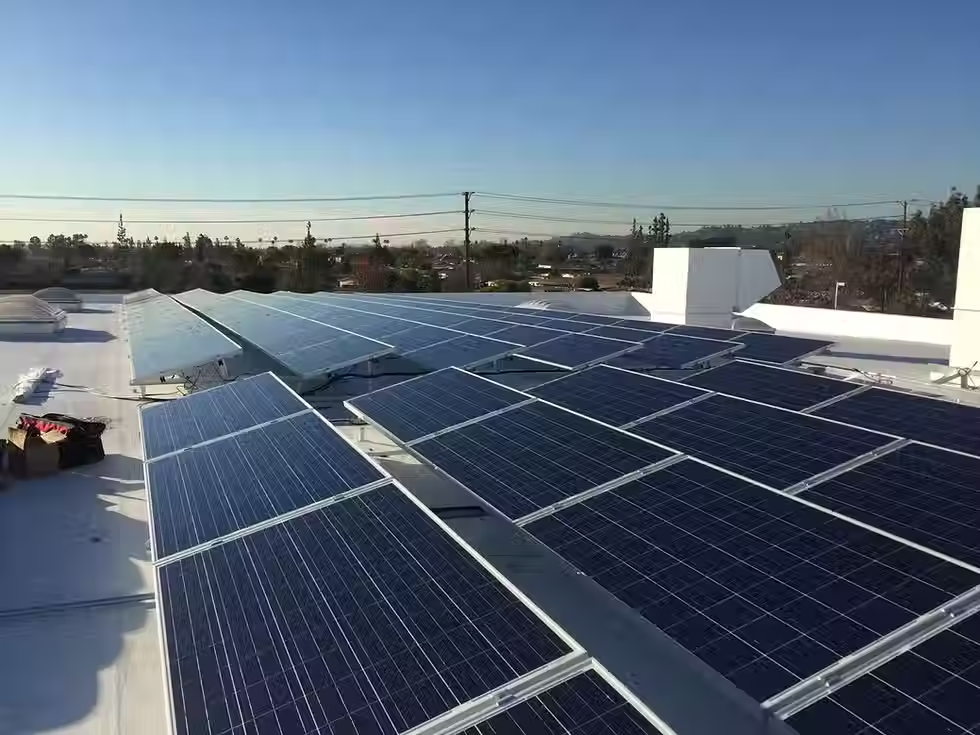
Solar panels account for roughly 40–60% of your installed system cost depending on panel type and brand. Monocrystalline panels offer higher efficiency (18–22% typical) and cost more per watt than polycrystalline; thin‑film costs less but requires more roof area. Panels are priced by watt: expect £0.40–£0.90 per watt for mainstream residential modules in 2026, so a 4 kW array typically costs £1,600–£3,600 for the modules alone.
You must also budget for racking and mounting hardware. Roof mounting brackets, rails and flashings add £150–£600 depending on roof complexity and material. Ground‑mount frames or tracking systems increase hardware costs substantially.
Pay attention to warranties and degradation rates. A 25‑year performance warranty and a <0.5% annual degradation rate can justify higher upfront cost through better long‑term output.
Inverter Types and Prices
The inverter converts DC from panels to AC for your home; its type affects efficiency and price. String inverters are the most common and cost about £500–£1,200 for typical residential units (3–6 kW). They offer good value if panels share consistent orientation and shading is minimal.
Microinverters and power optimisers handle panels individually, improving output under partial shading or mixed orientations. Microinverters cost roughly £70–£120 per panel; power optimiser systems add £40–£80 per panel plus a central inverter. Hybrid inverters, which integrate battery storage, start around £1,000 and rise with battery compatibility and features.
Factor in inverter lifespan and replacement cost. Inverters often need replacement after 10–15 years, so a cheaper inverter now may increase lifetime costs.
Labour and Professional Fees
Labour and professional fees typically form 15–35% of total installation cost, influenced by system size, roof pitch, access, and local labour rates. Expect £500–£1,500 for a straightforward 4 kW roof installation, rising to £2,000–£4,000 for complex roofs or scaffolding needs.
Design, permitting and electrical certification carry additional fixed fees. Site surveys and system design usually cost £100–£400; building regulation and grid‑connection paperwork can add £100–£500. If you require structural assessments or planning permission for listed buildings, those professional fees can exceed £1,000.
Choose certified installers (MCS or equivalent) to ensure compliance and eligibility for warranties and insurance. Ask for itemised quotes so you can compare labour hours, warranty terms and responsibilities for post‑installation support.
Long-Term Financial Impacts
Potential Savings on Energy Bills
Your direct saving equals the amount of grid electricity you no longer buy. For example, if you consume 8,000 kWh/year and your solar offsets 60% of that at a grid price of £0.34/kWh, you save about £1,632 annually (8,000 × 0.60 × £0.34). Savings vary with system size, orientation, shading, and household consumption patterns.
Export revenues and time-of-use pricing can increase value. If you export 2,000 kWh/year and receive 5.5p/kWh via a Smart Export Guarantee, that adds roughly £110 annually. If you shift consumption to daytime (EV charging or appliances), you can further boost self-consumption and raise effective savings.
Maintenance costs slightly reduce net savings. Budget about £100–£300 every few years for inverter replacement or cleaning. Factor modest inflation in electricity prices; a 3–5% annual rise increases long-term savings significantly.

Why Choose Solar Panel Installation London
When considering solar panel installation London, it’s essential to work with experienced professionals. Solar panels London offers tailored solutions and local expertise, ensuring your solar panel installation London is optimised for your property and energy needs. With Solar panels London, you benefit from a detailed site survey, high-quality components, and comprehensive aftercare.
Solar panel installation London can increase your property value and reduce your carbon footprint. Solar panels London provides transparent pricing and guides you through available incentives, making your switch to solar panel installation London as smooth as possible.
Contact Solar panels London today to get a personalised quote and start your journey towards energy independence with expert solar panel installation London.
Payback Period for Solar Investments
Calculate payback by dividing your net installed cost by annual net savings. Example: a £10,000 system with £1,600 yearly savings and £150 annual maintenance yields net annual benefit £1,450, giving a payback ≈ 6.9 years (£10,000 ÷ £1,450).
Key variables that shorten payback for solar panel installation London:
Higher self-consumption (use on-site storage or load shifting).
Higher local electricity prices.
Upfront grants or VAT-reduced rates where applicable.
Larger systems aligned to your household’s daytime demand.
Variables that lengthen payback:
High initial cost per watt (complex roofs, ground mounts).
Low export tariffs and poor solar access.
Significant financing interest—compare cash purchase vs financed scenarios.
For help finding qualified professionals, read our blog “Solar Panel Installers Near Me” to connect with trusted local experts.
Use a simple table to model scenarios for solar panel installation London quickly:
Item | Conservative | Typical | Optimistic |
Installed cost | £11,000 | £9,500 | £8,000 |
Annual net savings | £1,000 | £1,600 | £2,200 |
Payback (years) | 11.0 | 5.9 | 3.6 |
Run your own numbers with current tariffs, expected degradation (≈0.5–0.8%/year), and realistic self-consumption rates for an accurate payback estimate. For expert guidance on solar panel installation London, contact Solar panels London. Solar panels London can help you assess the best options for your property and maximise your investment in solar panel installation London.


Comments