
How to Install Solar Panels: A Clear, Step‑by‑Step Guide for Homeowners

Installing solar panels is straightforward when you know the steps and prepare properly, and you can often complete a basic rooftop system in a few days with the right tools and safety measures. You’ll assess your roof, choose compatible panels and mounts, secure permits, wire the inverter and panels, and connect to your consumer unit or export meter to start generating electricity.
You’ll save money and reduce emissions, but the quality of the outcome depends on careful planning: checking roof condition, shading, orientation, and local regulations before buying equipment. Follow clear guidance and you’ll avoid common mistakes like undersized inverters, poor mounting, or incorrect wiring. Working with a trusted home solar installer like Solar Panels London ensures you receive expert advice and a smooth installation process.
Key Takeaways
Check roof suitability and permissions before purchasing equipment.
Gather correct parts and safety gear to streamline installation.
Follow a clear wiring and commissioning sequence to start producing power.

Preparing for Solar Panel Installation
You’ll need to evaluate sunlight exposure, roof condition, system size and legal requirements before installation. Gather measurements, recent electricity bills and local planning rules to make informed choices. A reputable home solar installer such as Solar Panels London can guide you through this process.
Assessing Your Home’s Solar Potential
Start by measuring roof orientation, tilt and usable area in metres. South-facing roofs without shade produce the most energy; east- or west-facing roofs work but yield less. Use a smartphone sun-path app or hire a surveyor to record shading from trees, chimneys and neighbouring buildings at different times of day.
Check roof condition and age. Asphalt tiles older than 20 years, rotten timber or loose flashing require repair or replacement before panels go on. Confirm rafters and fixings can support added load — typical panel arrays add about 15–25 kg/m².
Estimate energy needs from 12 months of electricity bills. Calculate desired system size in kilowatts (kW) by dividing annual kWh by expected annual output per kW for your location (approx. 900–1,100 kWh/kW in the UK). This gives a realistic target for panel count and inverter size.
Choosing the Right Solar Panel System
Decide between monocrystalline and polycrystalline panels. Monocrystalline offers higher efficiency and smaller footprint; polycrystalline costs less but needs more roof area. Compare panel efficiency (%) and temperature coefficient for realistic output in heat.
Select an inverter type: string inverters are cost‑effective for uniform roofs; microinverters or power optimisers suit complex roofs and shading issues. Specify inverter capacity to match total panel DC rating, typically 80–120% of inverter AC rating depending on design.
Consider battery storage if you want backup or to maximise self‑consumption. Match battery capacity (kWh) to your overnight and peak needs; for most homes 5–13 kWh covers evening use and some resilience. Check warranties (minimum 10 years for panels, 5–12 years for inverters, 5–15 years for batteries) and performance guarantees.
Understanding Permits and Regulations
Check local planning rules and building regulations before ordering equipment. In the UK, most domestic rooftop solar falls under permitted development, but conservation areas, listed buildings or changes to roofline may need planning permission. Contact your local planning authority for clarification.
Arrange an electrical connection agreement with your Distribution Network Operator (DNO) if exporting or installing systems above certain sizes. Notify your DNO and apply for a generation export meter if required. For battery systems, inform both the DNO and your insurer.
Hire an MCS‑certified home solar installer to ensure eligibility for export schemes and compliance with standards. Solar Panels London, as a leading home solar installer, provides written quotations detailing equipment models, mounting method, warranties, expected annual generation and commissioning tests. Keep copies of all permits, certificates and commissioning records for future resale or warranty claims.

Step-By-Step Solar Panel Installation Process
You will prepare the site, mount racking and panels, complete electrical connections, and run tests to confirm performance and safety. Follow precise measurements, manufacturer instructions, and local electrical codes at each stage. Solar Panels London, your trusted home solar installer, recommends following these steps for optimal results.
Site Preparation and Safety Measures
Survey your roof or ground area for orientation, shading, and structural capacity. Measure roof pitch, azimuth, and available unobstructed area; verify your roof can support the dead and live loads specified by the racking manufacturer.
Clear debris, trim overhanging branches, and mark panel layout to avoid vents, chimneys and skylights. Install temporary fall protection (guardrails, harness anchor points) and use non-slip footwear and ladder stabilisers for roof access.
Gather PPE: hard hat, gloves, safety glasses, harness with shock absorber, and insulated tools. Switch off building circuits when working near electrical equipment and keep a fire extinguisher rated for electrical fires nearby.
Obtain necessary permits and notify your distribution network operator if required. Have structural engineer sign-off if you alter rafters or add heavy ballast for flat roofs.
Mounting Solar Panels
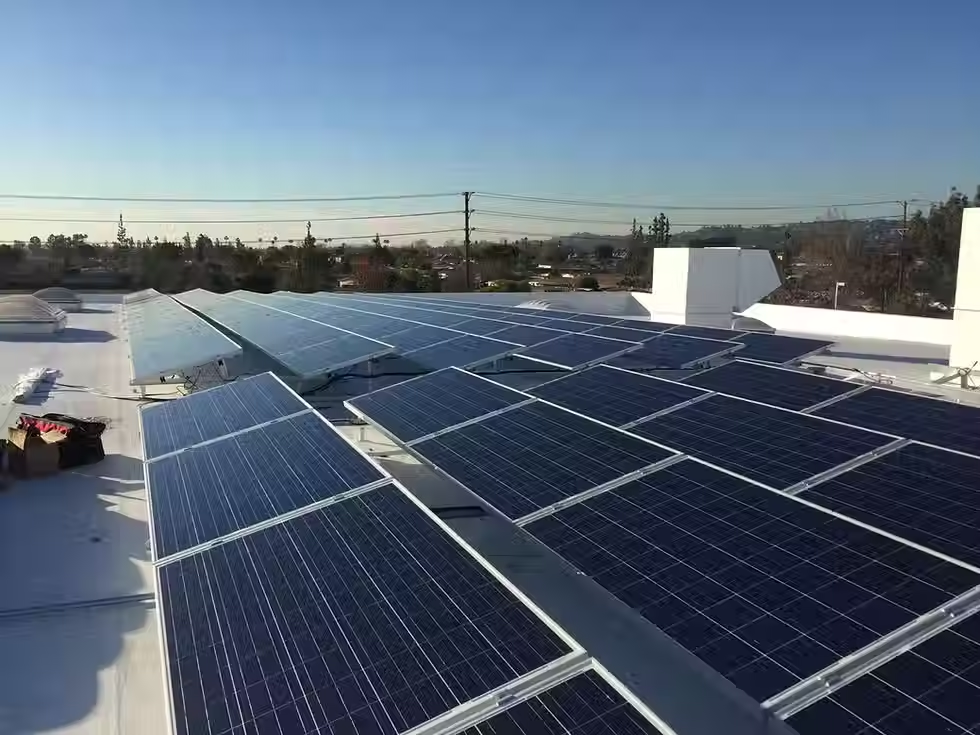
Choose compatible racking for tile, slate, metal or flat roofs. For tiled roofs, remove tiles at mount locations and use flashing kits; for metal roofs, use clamp systems or seam hooks per manufacturer instructions.
Mark rail positions using your panel layout and ensure rails run parallel to eaves. Fix rails to rafters with appropriately sized lag bolts or rail-specific screws; use a torque wrench to meet torque specs and install EPDM or neoprene washers to prevent leaks.
Attach mid and end clamps, then lift panels onto rails with at least two people or mechanical lifters for large modules. Tighten clamps to manufacturer torque values and check module alignment and wire routing channels to avoid pinch points.
On flat roofs use tilted ballast frames or anchored mounts; calculate ballast weight to resist wind uplift using local wind-speed data. Apply roof membrane protection pads under ballast to prevent damage.

Electrical Wiring and Connection
Plan cable runs from modules to the inverter using the shortest practical route while avoiding hot spots and sharp bends. Use PV-rated DC cable (typically 1.5mm²–6mm² depending on current) with UV-resistant outer sheath; size cables to limit voltage drop to under 2–3% where possible.
Install string combiners or rapid shutdown devices as required by local codes. Fit inline DC isolators and labelled fuse protection on each string before the inverter. Observe correct polarity and use MC4 or manufacturer-approved connectors; crimp and heat-shrink all cable junctions.
Mount the inverter near the distribution board on a vibration-free vertical surface, keeping ambient temperature within the inverter’s spec. Run AC cable from inverter to consumer unit using appropriately sized multicore cable and fit an RCD/MCB dedicated to the PV system.
Earthing: connect module frames, racks and inverter earths to a common earth bar using suitable conductor (often 6mm² copper) and install surge protection devices on both DC and AC sides where recommended.
For a seamless and safe installation, consider hiring a professional home solar installer like Solar Panels London. Their expertise ensures every step, from site assessment to final commissioning, is completed to the highest standards.
For a deeper dive, check out our guides on “Home solar system installation” and “Are solar panels worth installing” to plan your project with confidence.
System Testing and Commissioning
Solar Panels London, your trusted home solar installer, will inspect all mechanical fastenings, torque values, and sealants before energising your system. The home solar installer ensures that cable glands are tight, connectors are engaged, and labels are in place for emergency services and maintenance.
Solar Panels London performs insulation resistance tests on DC cabling with a PV-rated tester to confirm no leakage, comparing results against manufacturer minimums. The home solar installer checks continuity of earthing conductors and confirms correct polarity at inverter DC inputs.
Solar Panels London starts the PV system in accordance with the inverter start-up procedure. The home solar installer performs initial firmware checks, configures system settings (array size, grid parameters, anti-islanding), and enables MPPT operation. Live inverter readings are monitored for expected open-circuit voltage and string current balance.
Record commissioning measurements, including array voltage/current, inverter efficiency, AC export limits, and RCD operation times. Solar Panels London, as your home solar installer, photographically documents the installation and files commissioning certificates and grid-connection paperwork as required.


Comments